

Illustrative images
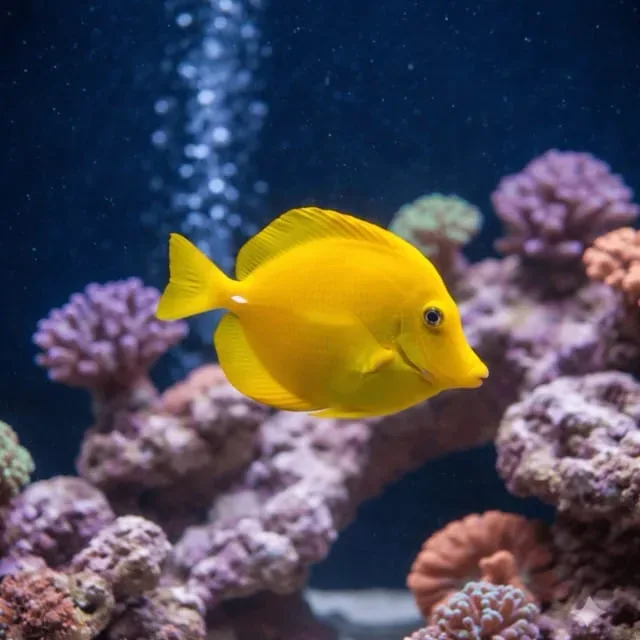
Yellow Tang
Zebrasoma flavescens
Overview
The Yellow Tang, scientifically known as Zebrasoma flavescens, is a popular and vibrant marine fish that belongs to the family Acanthuridae. It is well-known among aquarium hobbyists for its striking yellow coloration and lively personality. Native to the warm waters of the Pacific Ocean, particularly around the Hawaiian Islands, it thrives in coral reef environments, where it plays a crucial role in maintaining algae growth on the reef.
Natural Habitat
In its natural habitat, the Yellow Tang is typically found in shallow, tropical reef environments, where it feeds on algae growing on rocks and corals. Its bright coloration serves as a form of camouflage among the coral, helping it avoid predators.
Care Requirements
Caring for a Yellow Tang in an aquarium setting requires attention to their specific needs:
- Tank Size: It is recommended to keep Yellow Tangs in a minimum tank size of 75 gallons due to their active swimming nature.
- Water Conditions: Maintain stable water parameters, including a salinity of 1.020-1.025 and a temperature range of 72-78°F (22-26°C).
- Filtration: High-quality filtration is essential to keep the water clean and free from toxins, as Yellow Tangs are sensitive to poor water quality.
Tank Setup
When setting up a tank for a Yellow Tang, consider the following:
- Rockwork: Provide plenty of live rock for hiding and grazing; this mimics their natural habitat and provides essential surfaces for algae growth.
- Coral Placement: While Yellow Tangs can coexist with corals, ensure there is ample space to prevent territorial disputes with other fish.
Compatibility
Yellow Tangs are generally considered semi-aggressive and can be territorial, especially males. They do best in larger tanks where they can establish their own territory. They are compatible with many peaceful to semi-aggressive fish; however, caution should be taken when introducing multiple Tangs into the same tank.
Feeding
Yellow Tangs are herbivores and require a diet rich in algae. High-quality flake foods, frozen spirulina, and pieces of nori (seaweed) are recommended. Regular feeding ensures they receive adequate nutrition and helps prevent health issues related to malnutrition.
Lifespan
With proper care, a Yellow Tang can live for 8 to 12 years in captivity, making them a long-term commitment for aquarium owners.
How to care for Yellow Tang
- 1
Set up the tank
Prepare a well-cycled, uncrowded tank of at least 100 gallons with ample swimming space and live rock for grazing.
- 2
Acclimate slowly
Introduce the Yellow Tang to the tank gradually to minimize stress and allow it to adjust to its new environment.
- 3
Maintain water parameters
Keep water temperature between 72°F and 82°F (22°C to 28°C), pH between 8.1 and 8.4, and salinity at 1.023–1.026.
- 4
Provide a proper diet
Feed a variety of marine algae, nori, and algae-based prepared foods daily. Occasional supplements of meaty foods like mysis or brine shrimp can be offered.
- 5
Monitor tank mates
Ensure tank mates are compatible and avoid keeping multiple tangs or similarly shaped fish to prevent aggression.
- 6
Monitor health
Regularly check for signs of stress or disease, such as color fading or lesions, and address promptly.
Frequently asked questions
What size tank does a Yellow Tang need?▾
A Yellow Tang requires a minimum tank size of 100 gallons (approximately 380 liters) to accommodate its active swimming behavior and territorial nature.
What is the ideal water temperature for Yellow Tangs?▾
Yellow Tangs thrive in water temperatures between 72°F and 82°F (22°C to 28°C).
What do Yellow Tangs eat?▾
Yellow Tangs are primarily herbivorous, feeding on marine algae, nori (seaweed), and algae-based prepared foods. Occasional supplements of meaty foods like mysis or brine shrimp can be offered.
Are Yellow Tangs reef-safe?▾
Yes, Yellow Tangs are reef-safe and generally do not harm corals or invertebrates.
Can Yellow Tangs be kept with other tangs?▾
Yellow Tangs can be territorial, especially towards other tangs or similarly shaped fish. In tanks under 125 gallons, it's best to keep them singly. In larger systems (180+ gallons), they can be kept with other tang species if introduced simultaneously.