

Illustrative images
Tiger Barb
Puntigrus tetrazona
Overview
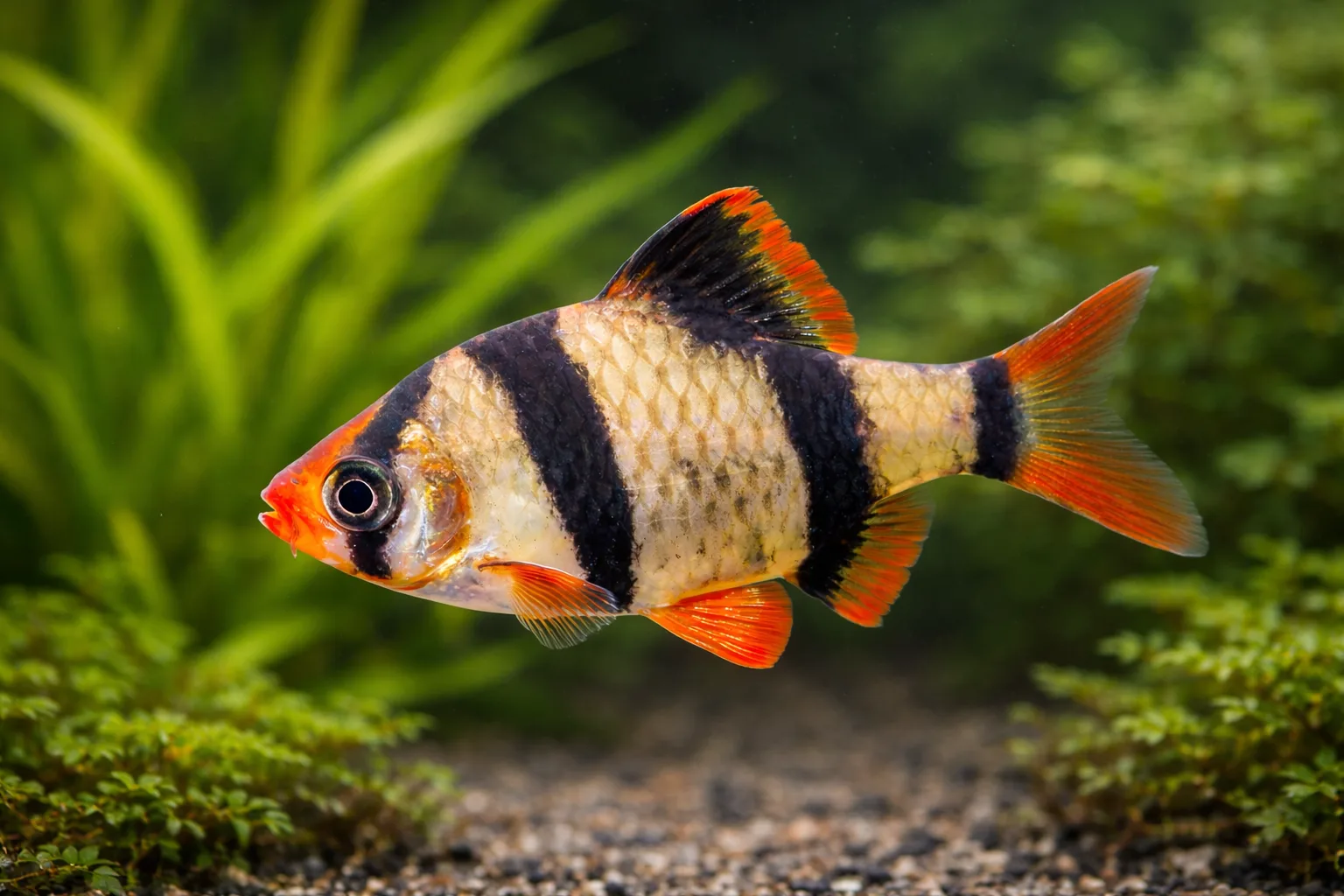
The Tiger Barb, scientifically known as Puntigrus tetrazona, is a popular freshwater fish, well-loved for its vibrant colors and active behavior. These small schooling fish are native to Southeast Asia, particularly found in rivers across Indonesia, Malaysia, and Thailand. They are a highlight in community tanks due to their lively nature and striking appearance.
Natural Habitat
Tiger Barbs thrive in the warm, slow-moving waters of dense forests and heavily planted areas. Their natural habitats are often characterized by moderate water flow and plenty of vegetation, which they use for cover and breeding. In the wild, they are typically found in schools, a behavior that is critical to their well-being.
Care Requirements
Caring for Tiger Barbs is relatively straightforward, but they do require specific conditions to thrive.
Tank Setup
A minimum tank size of 20 gallons is recommended for a small school of Tiger Barbs. The aquarium should be well-planted with plenty of hiding spots, such as driftwood and rocks, to mimic their natural environment. A soft substrate can also help to create a comfortable living space. Filtration should be efficient, but avoid strong currents that can stress the fish.
Water Conditions
- pH: 6.0 - 7.5
- Temperature: 24°C - 27°C (75°F - 81°F)
- Hardness: 5 - 20 dGH
Feeding
Tiger Barbs are omnivores, and a varied diet will ensure their health. They thrive on high-quality flake food, supplemented with live or frozen foods such as brine shrimp, daphnia, and bloodworms. Occasional plant-based foods like blanched vegetables or algae wafers can also be beneficial for their nutrition.
Compatibility
These fish are known for their semi-aggressive behavior, particularly when kept in smaller groups. It is best to keep them in groups of at least 6 to minimize aggression among themselves. Tiger Barbs tend to nip at the fins of slow-moving fish, so they should ideally be housed with other active species that can hold their own. Suitable tankmates include:
- Danios
- Guppies
- Platies
- Corydoras
Lifespan and Growth
In a well-maintained aquarium, Tiger Barbs can live for up to 5-7 years. They typically reach a maximum size of about 5 cm (2 inches) in length. Their striking appearance, marked by vertical black stripes and a golden-orange body, makes them an appealing choice for freshwater aquarists.
How to care for Tiger Barb
- 1
Set up the tank
Use a minimum of 25 gallons (95 liters) for a school of 6-8 Tiger Barbs. Provide an open swimming area with plants along the edges.
- 2
Acclimate slowly
Introduce Tiger Barbs to the tank gradually to reduce stress and prevent aggression.
- 3
Maintain water parameters
Keep the temperature between 74-79°F (23.3-26.1°C), pH between 6.0 and 7.0, and water hardness of 5-10 dGH.
- 4
Feed appropriately
Offer a varied diet including flake food, micro pellets, live or frozen foods like daphnia, brine shrimp, bloodworms, and blanched vegetables.
- 5
Monitor behavior
Observe for signs of aggression or fin-nipping. Ensure the school size is adequate to reduce such behaviors.
Frequently asked questions
What is the ideal tank size for Tiger Barbs?▾
A minimum of 25 gallons (95 liters) is recommended for a school of 6-8 Tiger Barbs. Larger tanks help reduce aggression and provide more territory.
What are the optimal water parameters for Tiger Barbs?▾
Maintain a temperature of 74-79°F (23.3-26.1°C), pH between 6.0 and 7.0, and water hardness of 5-10 dGH.
How many Tiger Barbs should be kept together?▾
Keep at least 6 Tiger Barbs together to prevent fin-nipping and aggression. Larger groups help diffuse aggression.
What are suitable tank mates for Tiger Barbs?▾
Compatible tank mates include other robust barbs, larger tetras, rasboras, loaches, and plecos. Avoid slow-moving or long-finned fish like angelfish and bettas.
What do Tiger Barbs eat?▾
Tiger Barbs are omnivorous and accept a varied diet, including flake food, micro pellets, live or frozen foods like daphnia, brine shrimp, bloodworms, and blanched vegetables.