

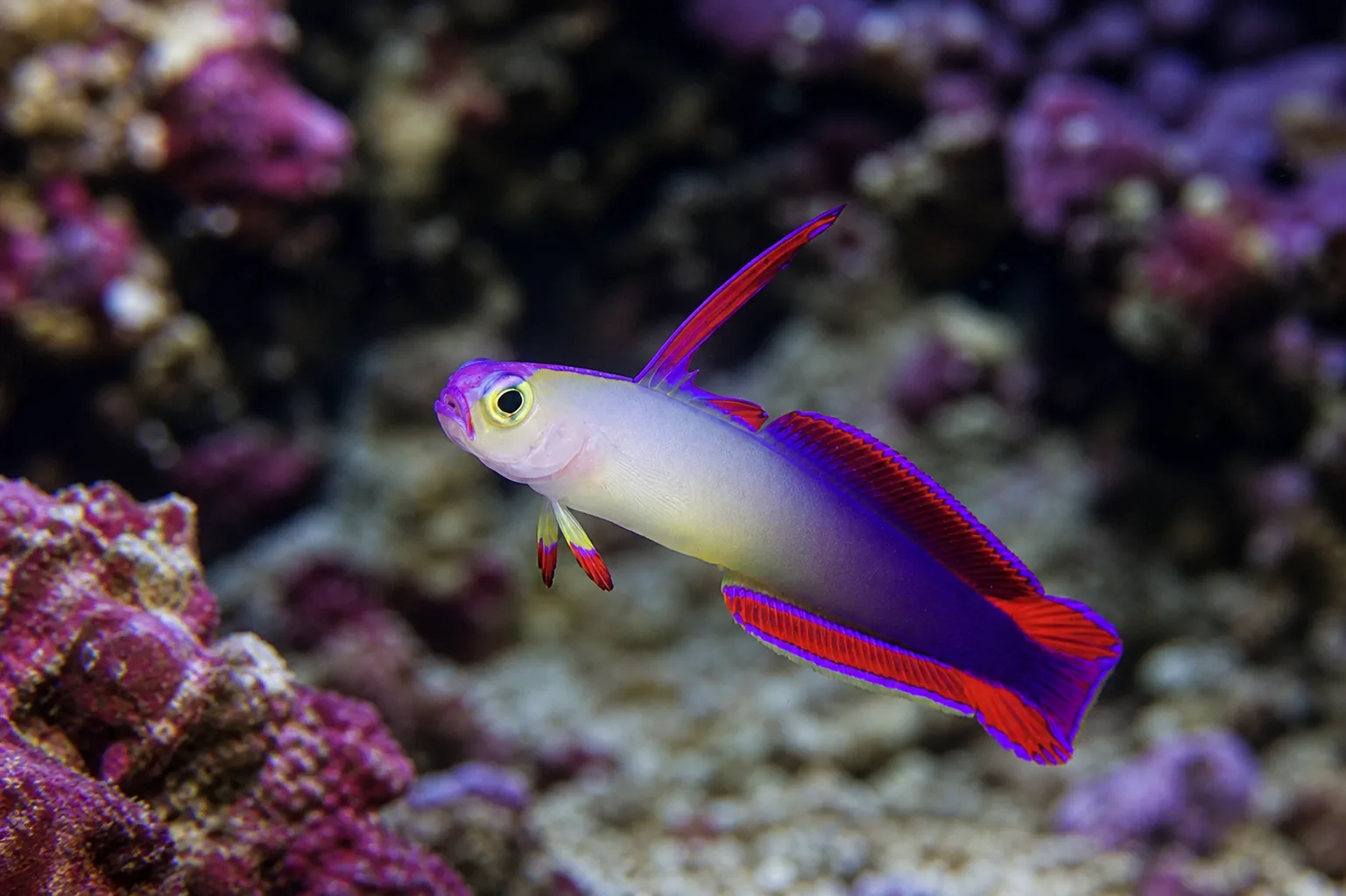
Illustrative images
Purple Firefish
Nemateleotris decora
Overview
The Purple Firefish, scientifically known as Nemateleotris decora, is a vibrant marine fish that is popular among aquarium enthusiasts due to its striking coloration and captivating behavior. This fish displays a beautiful gradient of purple and white, making it a delightful addition to reef tanks.
Natural Habitat
In the wild, Purple Firefish are typically found in the coral reefs of the Indo-Pacific region, including areas around the Red Sea, the Great Barrier Reef, and various Pacific islands. They inhabit sandy bottoms near coral formations, where they can quickly dart in and out of hiding spots to escape predators.
Care Requirements
Caring for Purple Firefish in captivity requires attention to water quality and suitable tank conditions. They are best kept in established reef aquariums with plenty of hiding places. A well-maintained tank will not only keep your Purple Firefish healthy but also promote its vibrant color.
Tank Setup
When setting up a tank for Purple Firefish, consider the following:
- Minimum Tank Size: A minimum of 50 gallons is recommended.
- Substrate: Fine sand or soft substrates work best, mimicking their natural habitat.
- Hiding Spots: Incorporate live rock and other decorations to provide hiding spots.
- Water Flow: Medium water flow is preferred, reflecting their natural environment.
Compatibility
Purple Firefish are generally peaceful and can coexist with a variety of marine species. However, they may be shy and require the companionship of peaceful fish. Avoid housing them with aggressive or overly active fish that may intimidate them.
Tank Mates
Good tank mates include:
- Clownfish
- Gobies
- Other peaceful wrasses
Feeding
Purple Firefish are carnivorous and should be fed a varied diet that includes high-quality flakes, pellets, and frozen or live foods such as brine shrimp and mysis shrimp. Regular feeding 2-3 times a day is recommended to maintain their health and vibrant coloration.
Water Parameters
- pH: 8.1 - 8.4
- Temperature: 24 - 28°C
- Salinity: 1.020 - 1.025 SG
Lifespan
With proper care, Purple Firefish can live for up to 5 years in captivity.
Conclusion
The Purple Firefish is a stunning marine fish that is well-suited for reef tanks. With its peaceful demeanor and beautiful appearance, it is an ideal choice for many marine aquarium hobbyists.
How to care for Purple Firefish
- 1
Set up the tank
Prepare a 20-gallon (75-liter) aquarium with live rock and a sandy substrate to mimic the Purple Firefish's natural habitat.
- 2
Acclimate slowly
Introduce the Purple Firefish to the tank gradually to reduce stress and allow it to adjust to the new environment.
- 3
Maintain water parameters
Keep water temperature between 72°F and 79°F (22°C to 26°C), pH between 8.1 and 8.4, and salinity at 1.020-1.025 specific gravity.
- 4
Provide hiding spots
Ensure the tank has plenty of hiding places, such as caves or crevices, to make the Purple Firefish feel secure.
- 5
Feed appropriately
Offer a varied diet of meaty foods like brine shrimp, mysis shrimp, and finely chopped seafood to meet the Purple Firefish's carnivorous needs.
- 6
Monitor behavior
Observe the Purple Firefish for signs of stress or aggression, especially if housing multiple individuals, as they can be territorial.
Frequently asked questions
What is the ideal tank size for Purple Firefish?▾
A minimum tank size of 20 gallons (75 liters) is recommended for Purple Firefish.
What are the water temperature requirements for Purple Firefish?▾
Purple Firefish thrive in water temperatures between 72°F and 79°F (22°C to 26°C).
What is the maximum size of Purple Firefish?▾
Purple Firefish can grow up to 4 inches (10 cm) in length.
Are Purple Firefish reef-safe?▾
Yes, Purple Firefish are considered reef-safe and can be kept in reef aquariums.
What is the lifespan of Purple Firefish?▾
Purple Firefish typically live for 3 to 5 years in captivity.