

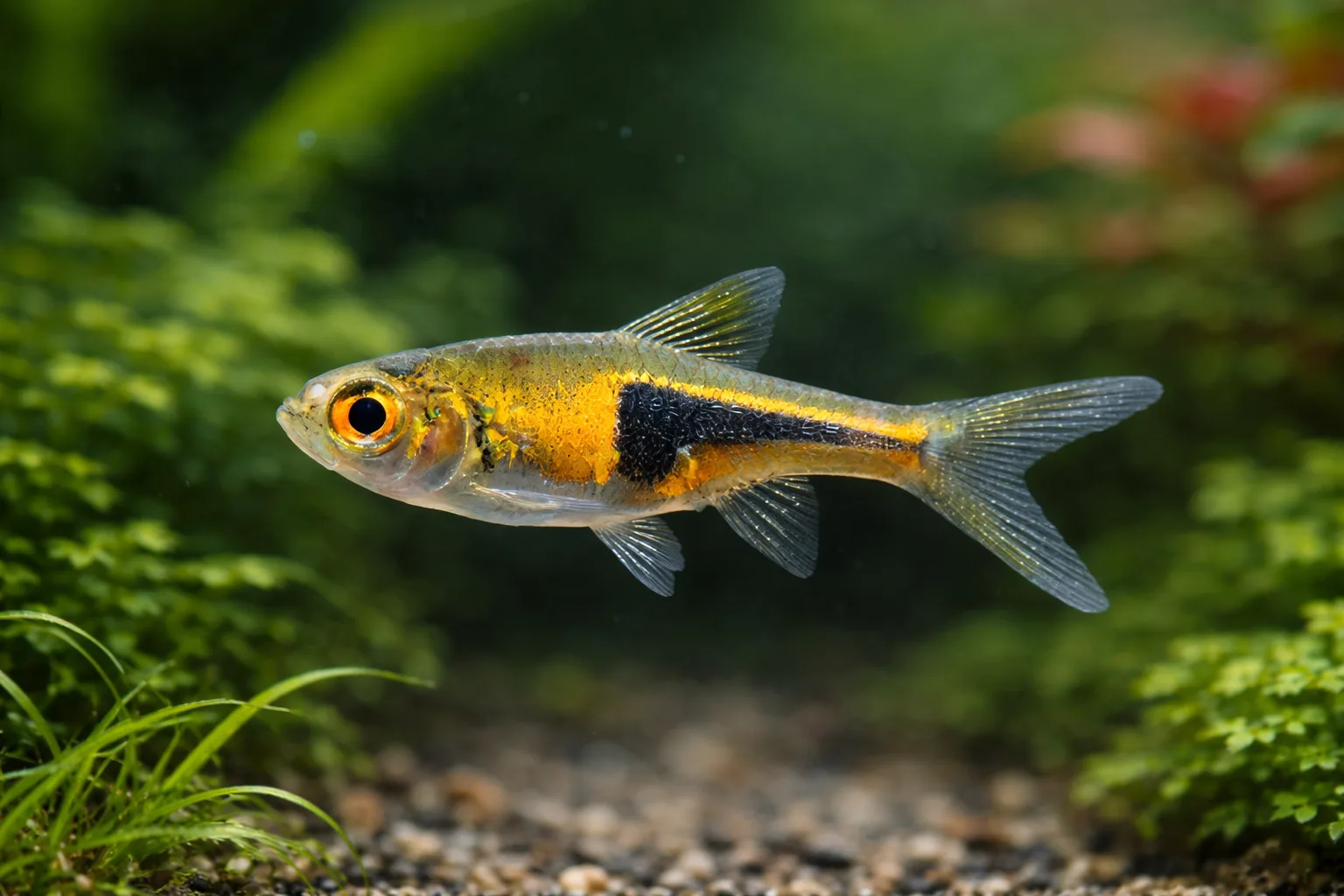
Illustrative images
Lambchop Rasbora
Trigonostigma espei
Overview
The Lambchop Rasbora, scientifically known as Trigonostigma espei, is a small freshwater fish popular among aquarists due to its peaceful nature and attractive appearance. It features a unique body shape and a coloration that makes it stand out in a community aquarium.
Natural Habitat
This species is native to the waters of Southeast Asia, particularly in Malaysia and Thailand. In its natural habitat, the Lambchop Rasbora is often found in slow-moving streams and rivers, where it resides among dense vegetation and submerged structures.
Care Requirements
The Lambchop Rasbora is generally considered an easy species to care for, making it suitable for beginners. To create a suitable environment for this fish, consider the following:
- Min Tank Size: A minimum of 30 liters is recommended for a small group.
- Water Type: It thrives in freshwater environments.
- Temperature: The ideal range is between 22°C to 28°C.
- pH Level: A pH of 6.0 to 7.5 is suitable.
- General Hardness: Soft to moderately hard water (4-15 dGH) is preferable.
Tank Setup
When setting up a tank for Lambchop Rasboras, mimic their natural environment by including plenty of plants and hiding spots. Use fine substrates and create open swimming spaces. Darker gravel and subdued lighting enhance their coloration and well-being.
Compatibility
Lambchop Rasboras are social and peaceful fish, which makes them great community tank inhabitants. They can be kept with various species, including:
- Other small, peaceful fish (such as tetras and guppies)
- Bottom dwellers (like shrimp or small catfish)
However, avoid aggressive species that may stress or harm them.
Feeding
Lambchop Rasboras are omnivores and thrive on a varied diet, which should include:
- High-quality flake or pellet food
- Frozen or live foods like daphnia, brine shrimp, and bloodworms
- Vegetable matter such as spirulina or finely chopped greens
Feeding them a balanced diet will promote their health and vibrant coloration.
Lighting and CO2
Lighting should be moderate; strong light can lead to algae growth and stress the fish. If keeping live plants, consider providing CO2 supplementation to enhance plant growth, but this is not mandatory for the health of Lambchop Rasboras.
Conclusion
The Lambchop Rasbora is an excellent choice for aquarists of all levels who are looking to create a lively and colorful community tank. Their small size, sociable nature, and ease of care make them a delightful addition to any freshwater aquarium.
How to care for Lambchop Rasbora
- 1
Set up the tank
Use a minimum 15-gallon (60-liter) tank with a dark substrate and plenty of aquatic plants like Cryptocoryne to replicate their natural habitat.
- 2
Maintain water parameters
Keep the water temperature between 73°F and 82°F (23°C to 28°C), pH between 5.5 and 7.5, and hardness between 2 and 12 dGH.
- 3
Acclimate the fish
Introduce Lambchop Rasboras to the tank slowly to minimize stress, especially when adding them to an established aquarium.
- 4
Feed appropriately
Provide a varied diet of high-quality flakes, micro pellets, and live or frozen foods like daphnia and brine shrimp.
- 5
Monitor water quality
Regularly check water parameters and perform partial water changes to maintain optimal conditions.
Frequently asked questions
What is the ideal tank size for Lambchop Rasboras?▾
A minimum tank size of 15 gallons (60 liters) is recommended for a small school of Lambchop Rasboras.
What water temperature do Lambchop Rasboras prefer?▾
Lambchop Rasboras thrive in water temperatures between 73°F and 82°F (23°C to 28°C).
What pH level is best for Lambchop Rasboras?▾
A pH level between 5.5 and 7.5 is ideal for Lambchop Rasboras.
What is the lifespan of Lambchop Rasboras?▾
Lambchop Rasboras typically live for 4 to 6 years.
What do Lambchop Rasboras eat?▾
Lambchop Rasboras are omnivores, feeding on high-quality flakes, micro pellets, and live or frozen foods like daphnia and brine shrimp.