

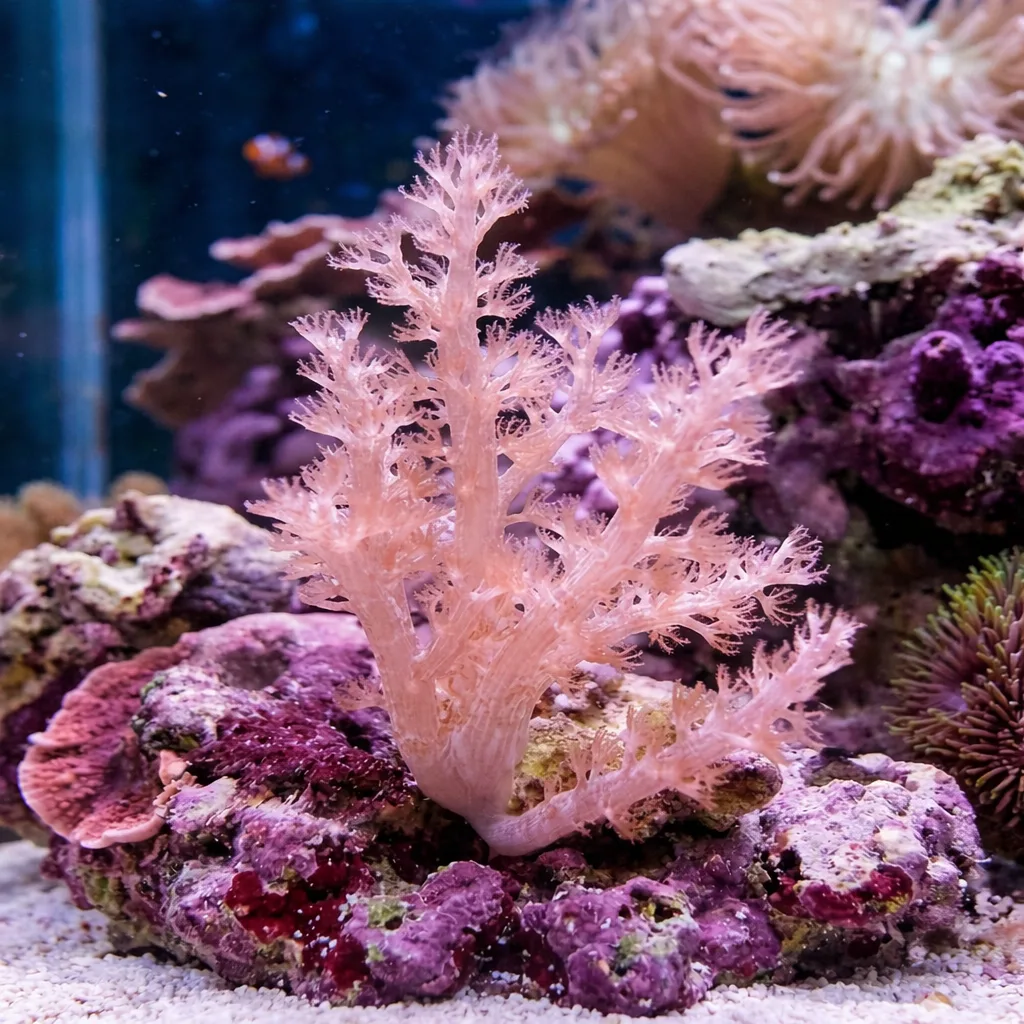
Illustrative images
Kenya Tree Coral
Capnella sp.
The Kenya Tree Coral (Capnella sp.) is one of the most popular and beginner-friendly soft corals in the reef aquarium hobby. Known for its tree-like branching structure and soft flowing polyps, this coral adds height, movement, and a natural reef appearance to marine aquariums. Native to the Indo-Pacific region, Kenya Tree Coral commonly grows on reef slopes and shallow lagoon environments where moderate currents are present.
Kenya Tree Coral forms a thick central stalk with multiple branching arms, giving it a miniature tree appearance underwater. Each branch is covered with tiny polyps that extend outward, creating a feathery texture when the coral is fully open. The coloration is typically light brown, tan, pink, or beige, though under reef aquarium lighting it may appear slightly translucent with soft pastel tones.
Unlike stony corals, Kenya Tree Coral belongs to the soft coral family, meaning it does not build a rigid calcium skeleton. Instead, its structure is supported by microscopic elements called sclerites, which help the coral maintain its shape while still allowing it to sway naturally in the current.
One of the main reasons Kenya Tree Coral is so widely kept is its hardiness and adaptability. It tolerates a wide range of reef tank conditions and can thrive in both beginner and established aquariums.
For best results, Kenya Tree Coral prefers moderate lighting and gentle to moderate water flow. Adequate water movement helps keep the coral clean and encourages its characteristic swaying motion.
Recommended reef parameters include:
-
Temperature: 24–26°C (75–79°F)
-
Salinity: 1.024–1.026
-
Alkalinity: 8–9 dKH
-
Calcium: 380–450 ppm
-
Magnesium: 1200–1350 ppm
Kenya Tree Coral is photosynthetic, receiving most of its energy from symbiotic zooxanthellae algae through photosynthesis. It may also capture small suspended particles from the water column.
Another interesting trait is its natural propagation behavior. The coral often reproduces by dropping small branches that attach to nearby rock surfaces and grow into new colonies. Because of this fast reproduction, many aquarists place it in controlled areas of the aquascape.
With its soft movement, unique branching structure, and easy care requirements, the Kenya Tree Coral is an excellent addition to reef aquariums, especially for hobbyists looking to add a resilient and visually dynamic soft coral.
How to care for Kenya Tree Coral
- 1
Set up the tank
Ensure your aquarium has stable water parameters: temperature 72-78°F (22-26°C), salinity 1.024-1.026 specific gravity, pH 8.1-8.4, alkalinity 8-11 dKH, calcium 400-450 ppm, magnesium 1250-1350 ppm, nitrates below 5 ppm, and phosphates below 0.03 ppm.
- 2
Position the coral
Place the Kenya Tree Coral in the middle third of the tank, providing moderate lighting (PAR 80-250) and moderate water flow to support its growth.
- 3
Acclimate the coral
Before introducing the coral to the tank, acclimate it slowly to match the tank's water parameters, reducing stress and promoting successful establishment.
- 4
Monitor water quality
Regularly test and maintain water parameters, performing 10-20% weekly water changes to replenish trace elements and remove waste.
- 5
Feed appropriately
Offer small amounts of phytoplankton or coral-specific foods a couple of times per week, avoiding overfeeding to maintain water quality.
- 6
Monitor coral health
Observe the coral for signs of stress or disease, such as retracted polyps or discoloration, and address any issues promptly.
Frequently asked questions
What are the ideal water parameters for Kenya Tree Coral?▾
Maintain water temperature between 72-78°F (22-26°C), salinity at 1.024-1.026 specific gravity, pH between 8.1-8.4, alkalinity at 8-11 dKH, calcium levels between 400-450 ppm, and magnesium between 1250-1350 ppm. Keep nitrates below 5 ppm and phosphates below 0.03 ppm.
How should I position Kenya Tree Coral in my aquarium?▾
Place Kenya Tree Coral in the middle third of the tank, where it can receive moderate lighting (PAR 80-250) and moderate water flow. This placement supports its growth and health.
What lighting conditions are best for Kenya Tree Coral?▾
Provide moderate lighting with a PAR range of 80-250. Suitable lighting options include LED, metal halide, and T5 fluorescent lights.
How often should I feed Kenya Tree Coral?▾
While Kenya Tree Corals obtain nutrients through photosynthesis, they can benefit from supplemental feedings of small amounts of phytoplankton or coral-specific foods a couple of times per week.
Are Kenya Tree Corals aggressive towards other tank inhabitants?▾
Kenya Tree Corals are generally peaceful but can release chemicals that may harm nearby corals if they are too close. Ensure adequate space between corals to prevent potential issues.