

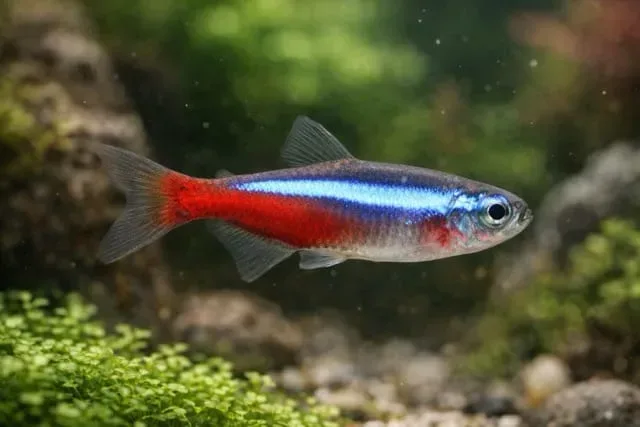
Illustrative images
Cardinal Tetra
Paracheirodon axelrodi
Overview
The Cardinal Tetra, scientifically known as Paracheirodon axelrodi, is a small freshwater fish native to the Amazon Basin in South America. Known for its striking coloration, this fish is a favorite among aquarists and is often found in community tanks. Their bright blue and red coloration makes them a standout in any aquarium setup.
Natural Habitat
Cardinal Tetras are typically found in the slow-moving waters of the Amazon River and its tributaries. They thrive in flooded tropical forests and prefer dimly lit environments with plenty of vegetation. The natural habitat provides them with plenty of cover and food sources, contributing to their peaceful nature.
Care Requirements
Cardinal Tetras are generally considered easy to care for, making them suitable for both beginner and experienced aquarists. Here are the key care requirements to keep them healthy:
Tank Setup
- Minimum tank size: 60 liters (15 gallons) is recommended for a small school.
- Water conditions should reflect their natural habitat: slightly acidic to neutral pH (around 6.0 to 7.0), soft to moderately hard water.
- Provide plenty of plants, driftwood, and hiding spots to mimic their natural environment and help reduce stress.
- Substrate can be fine gravel or sand, as this will be more comfortable for them.
Compatibility
Cardinal Tetras are known for their peaceful temperament and do well in community tanks. They can be housed with:
- Other small, peaceful fish like Neon Tetras, Rasboras, and some species of Gouramis.
- Avoid aggressive or larger species that might view them as prey.
Feeding
They are omnivorous and will accept a variety of foods. A balanced diet should include:
- High-quality flake or pellet food.
- Frozen or freeze-dried foods like bloodworms and brine shrimp.
- Supplement with vegetable matter, such as blanched lettuce or spirulina flakes.
Lighting and CO2
Moderate lighting is best for Cardinal Tetras, as they come from dimly lit habitats. They do not require high CO2 levels but will benefit from some CO2 injection if you have a heavily planted tank.
Specifications
- Maximum Size: Generally reaches about 4 cm in length.
- Lifespan: Typically 5 to 7 years with proper care.
- Swimming Level: They usually occupy the middle levels of the tank.
- Minimum Group Size: It is advisable to keep them in groups of at least 6 to maintain their natural schooling behavior.
- Temperament: Peaceful, suitable for community tanks.
How to care for Cardinal Tetra
- 1
Set up the tank
Choose a well-furnished aquarium with a dark bottom substrate and plenty of plants to replicate their natural habitat.
- 2
Acclimate slowly
Introduce Cardinal Tetras to the tank gradually to minimize stress and allow them to adjust to the new environment.
- 3
Maintain water parameters
Keep the water temperature between 73°F and 81°F (23°C to 27°C), with a pH of 4.5 to 7.0, and hardness between 2 and 12 dGH.
- 4
Feed appropriately
Provide a varied diet including flake food, live foods, and frozen foods to ensure balanced nutrition.
- 5
Monitor tank mates
Ensure compatibility with peaceful community fish and avoid aggressive species that may stress the Cardinal Tetras.
Frequently asked questions
What is the ideal tank size for Cardinal Tetras?▾
A minimum tank size of 20 gallons is recommended for a small school of Cardinal Tetras.
What water temperature do Cardinal Tetras prefer?▾
Cardinal Tetras thrive in water temperatures between 73°F and 81°F (23°C to 27°C).
What pH level is best for Cardinal Tetras?▾
Cardinal Tetras prefer a pH range of 4.5 to 7.0, favoring slightly acidic conditions.
How many Cardinal Tetras should be kept together?▾
It's best to keep Cardinal Tetras in groups of at least six to reduce stress and display natural schooling behavior.
What do Cardinal Tetras eat?▾
Cardinal Tetras are omnivores and can be fed flake food, live foods, and frozen foods.