

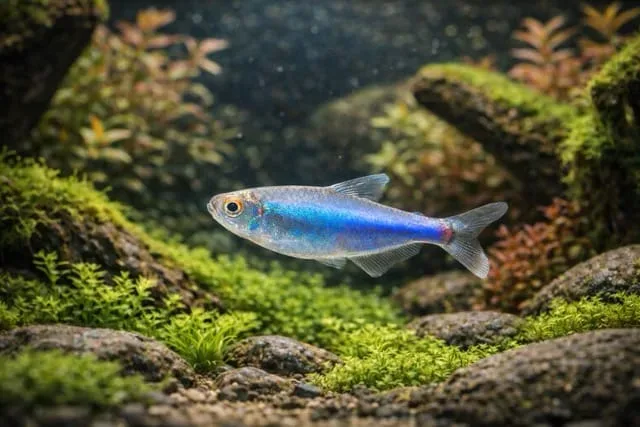
Illustrative images
Blue Tetra
Knodus borki
Overview
The Blue Tetra, scientifically known as Hyphessobrycon anisitsi, is a small freshwater fish that is popular among aquarists for its vibrant coloration and peaceful nature. This species is notable for its striking blue hue and is often seen in schools, making them a delightful addition to community tanks.
Natural Habitat
Blue Tetras are native to the clear waters of South America, particularly in rivers and streams in regions like Brazil and Paraguay. They thrive in slow-moving waters with plenty of vegetation, which provides both food and shelter from predators.
Care Requirements
Tank Setup
For successful keeping of Blue Tetras, it is essential to replicate their natural habitat. A well-planted aquarium with soft, dim lighting is ideal. Use fine gravel or sand as substrate, and incorporate plants such as Java moss, Hornwort, and other floating plants to create hiding spots and reduce light intensity.
Water Parameters
Blue Tetras prefer slightly acidic to neutral water conditions. Regular water changes and good filtration are crucial to maintain water quality.
- pH: 6.0 to 7.5
- Temperature: 22°C to 26°C (72°F to 78°F)
- Hardness: 6 to 12 dGH
Tank Compatibility
Blue Tetras are peaceful fish that do well in community tanks. They can be housed with a variety of other species such as:
- Guppies
- Neon Tetras
- Rasboras
- Dwarf Gouramis
Avoid aggressive or larger fish that may see them as prey. Keeping them in groups of at least six individuals is recommended to encourage their natural schooling behavior.
Feeding
Blue Tetras are omnivorous and will accept a wide variety of foods. A balanced diet should include high-quality flakes, micro pellets, and occasional live or frozen foods such as brine shrimp and daphnia. Regular feeding ensures they maintain their vibrant color and good health.
Lifespan
With proper care, Blue Tetras can live up to 5 years in an aquarium environment. Monitoring water quality and providing a varied diet can help them thrive.
Conclusion
Adding Blue Tetras to your aquarium can enhance its visual appeal and contribute to a dynamic community tank. Their peaceful nature and attractive coloration make them a suitable choice for both beginner and experienced aquarists.
How to care for Blue Tetra
- 1
Set up the tank
Choose a tank of at least 75 liters (20 gallons) with a dark substrate and plenty of live plants to mimic their natural habitat.
- 2
Acclimate slowly
Introduce Blue Tetras to the tank gradually to minimize stress, allowing them to adjust to the new environment.
- 3
Maintain water parameters
Keep the water temperature between 22°C and 26°C (72°F to 82°F), with a pH of 6.0 to 7.5 and hardness up to 15 dGH.
- 4
Feed appropriately
Provide a varied diet of high-quality flake foods, micro pellets, and live or frozen foods like brine shrimp and daphnia.
- 5
Monitor tankmates
Keep Blue Tetras with other small, peaceful fish to prevent aggression and fin-nipping.
- 6
Ensure oxygen-rich water
Maintain well-oxygenated water conditions to support the health and activity levels of Blue Tetras.
Frequently asked questions
What is the ideal tank size for Blue Tetras?▾
A minimum tank size of 75 liters (20 gallons) is recommended for Blue Tetras, providing ample space for swimming and schooling behavior.
What water parameters do Blue Tetras require?▾
Blue Tetras thrive in water temperatures between 22°C and 26°C (72°F to 82°F), with a pH range of 6.0 to 7.5 and hardness up to 15 dGH.
How many Blue Tetras should be kept together?▾
It's best to keep Blue Tetras in groups of at least 6 individuals to reduce stress and prevent fin-nipping behavior.
What is the maximum size Blue Tetras can reach?▾
Blue Tetras can grow up to 5 centimeters (1.97 inches) in length.
What is the lifespan of Blue Tetras?▾
Blue Tetras typically live for 2 to 4 years in a well-maintained aquarium.
What is the natural habitat of Blue Tetras?▾
Blue Tetras are native to the rivers and streams of Iquitos, Peru, where they inhabit densely vegetated, oxygen-rich waters.