

Illustrative images
Blue Tang
Paracanthurus hepatus
Overview
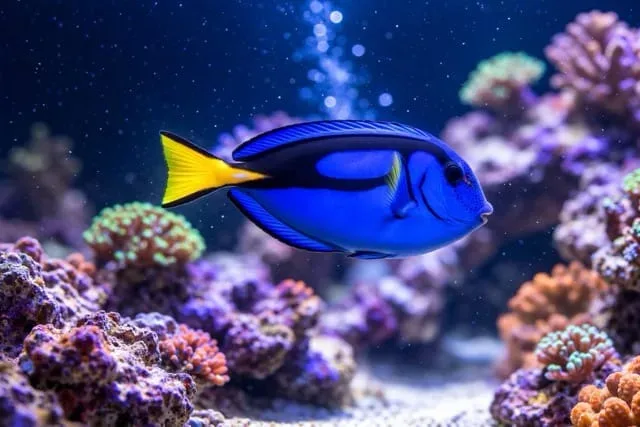
The Blue Tang, also known as the Palette Surgeonfish, is a popular marine fish native to the reefs of the Indo-Pacific region. It is renowned for its vibrant blue color and unique yellow tail, making it a favorite among aquarists. The scientific name for the Blue Tang is Paracanthurus hepatus. This species is a reef dweller and plays an important role in maintaining the health of coral ecosystems.
Natural Habitat
The Blue Tang primarily inhabits coral reefs and rocky areas where it can find plenty of algae to graze on. These fish are often found in schools, particularly during the juvenile stage, and are commonly observed swimming near the reef substrate. Their natural habitat plays a significant role in their diet and social structure.
Care Requirements
Blue Tangs are considered to be of medium care level due to their specific needs and social behaviors. Hobbyists should be mindful of the following:
- Tank Size: It is recommended to keep Blue Tangs in a minimum tank size of 75 gallons to provide them with ample swimming space.
- Water Quality: Like most marine fish, Blue Tangs require stable water parameters. Regular water changes and the use of a high-quality filtration system are essential to maintain ideal conditions.
- Salinity: A stable salinity level of 1.020 to 1.025 specific gravity is important for their health.
- Temperature: The ideal temperature range for Blue Tangs is between 24°C to 28°C (75°F to 82°F).
- pH Levels: Maintaining a pH between 8.1 and 8.4 is important for their well-being.
Tank Setup
When setting up a tank for Blue Tangs, include plenty of live rock and hiding spaces to mimic their natural environment. These fish appreciate an environment where they can graze on algae growing on rocks and surfaces. The addition of corals or other decorations can enhance the tank's aesthetics and provide cover.
Compatibility
Blue Tangs are generally semi-aggressive and can be territorial, particularly with other surgeonfish. It is advisable to introduce them in larger groups or pairs to spread out any aggression. Ideal tank mates include a variety of peaceful marine species, but caution should be taken when introducing similar-looking fish to avoid conflicts.
Feeding
In the aquarium, Blue Tangs are omnivorous and should be offered a varied diet. High-quality algae-based foods, such as nori or spirulina, along with meaty foods like mysis shrimp or finely chopped seafood, will keep them healthy. Regular feeding of small portions multiple times a day is beneficial for their growth and health.
Lifespan
In captivity, Blue Tangs can live up to 15 years when provided with proper care and a suitable environment.
How to care for Blue Tang
- 1
Set up a spacious tank
Provide a minimum of 75 gallons, with ample swimming space and live rock for grazing and hiding.
- 2
Acclimate the Blue Tang
Introduce the fish slowly to reduce stress, using a drip acclimation method over several hours.
- 3
Maintain stable water conditions
Regularly monitor and adjust temperature (73-81°F), pH (8.1-8.4), and salinity (1.020–1.025) to keep parameters stable.
- 4
Feed a varied diet
Offer marine algae, spirulina, and high-quality herbivore pellets, with occasional treats of mysis shrimp.
- 5
Monitor for signs of stress
Watch for reduced appetite, color fading, or unusual behavior, which may indicate health issues.
Frequently asked questions
What is the ideal tank size for a Blue Tang?▾
A minimum of 75 gallons is recommended, with larger tanks preferred for adult Blue Tangs.
What are the optimal water parameters for a Blue Tang?▾
Maintain a temperature of 73-81°F, pH between 8.1 and 8.4, and salinity at 1.020–1.025.
What do Blue Tangs eat?▾
They are primarily herbivores, feeding on algae and supplemented with meaty foods like mysis shrimp.
Are Blue Tangs reef-safe?▾
Yes, they are generally reef-safe but may occasionally nip at small invertebrates if not well-fed.
Can Blue Tangs be kept with other tangs?▾
They can be territorial towards other tangs; introducing them simultaneously in a large tank can reduce aggression.