

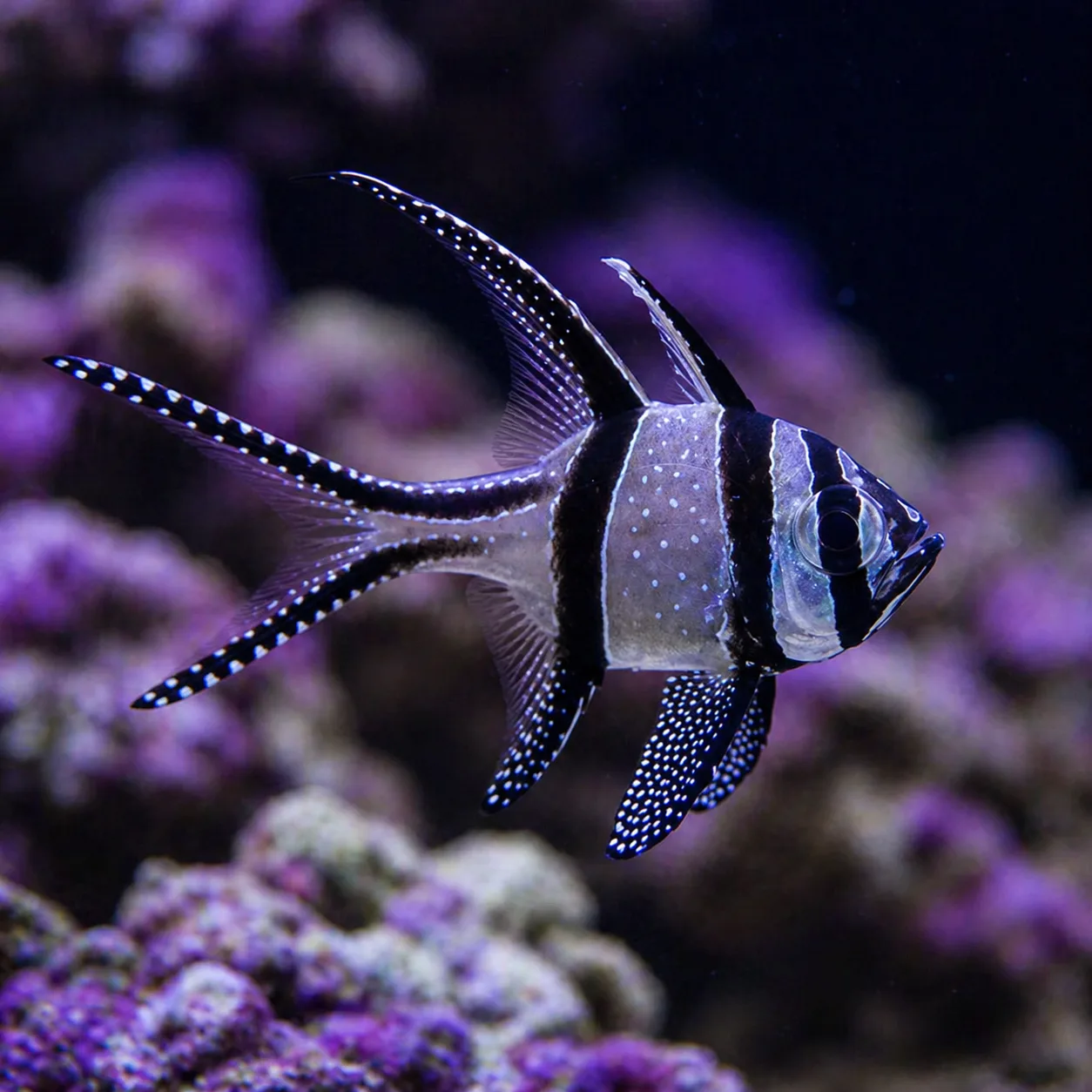
Illustrative images
Banggai Cardinalfish
Pterapogon kauderni
Overview
The Banggai Cardinalfish, scientifically known as Pterapogon kauderni, is a small, colorful marine fish that is popular among aquarium hobbyists. Native to the Banggai Islands of Indonesia, this species is renowned for its striking black and white coloration and peaceful nature. It is often kept in reef tanks, where it can showcase its beauty and unique behaviors.
Natural Habitat
The natural habitat of the Banggai Cardinalfish includes shallow waters near coral reefs and rocky outcrops. They are typically found in small groups, often establishing a territory around their chosen shelter, which could be crevices or areas with dense coral cover. In the wild, they have been observed forming pairs during breeding seasons.
Care Requirements
Caring for Banggai Cardinalfish in an aquarium is relatively straightforward, making them suitable for both beginners and experienced aquarists. They thrive in stable water parameters and do best in well-maintained tanks. Below are key care requirements:
- Water Type: Marine
- Tank Size: Minimum 50 liters (13 gallons)
- Temperature: 24-28 °C (75-82 °F)
- pH: 8.0-8.4
- Salinity: 1.020-1.025 specific gravity
Tank Setup
When setting up a tank for Banggai Cardinalfish, it is essential to replicate their natural environment as closely as possible. Here are some recommendations:
- Provide plenty of hiding spots with rocks, live coral, and other structures.
- Include open swimming space to allow for their natural swimming behavior.
- Maintain good water quality with a reliable filtration system and perform regular water changes.
- Ensure proper lighting that simulates their natural habitat without being too harsh.
Compatibility
Banggai Cardinalfish are generally peaceful and can be kept with a variety of tank mates. However, caution should be exercised when selecting companions. Consider the following:
- Best kept with other peaceful fish species.
- Avoid aggressive or territorial species that could harm them.
- They can be housed with invertebrates, but watch for any predation if they are kept with small shrimp or snails.
Feeding
The diet of Banggai Cardinalfish should consist of high-quality marine foods. They are omnivorous, and their diet can include:
- Marine flakes or pellets
- Frozen or live foods, such as brine shrimp and mysis shrimp
- Small pieces of seafood like fish or shrimp
It is crucial to feed them balanced meals to maintain their health and color.
Lifespan
Under optimal conditions, Banggai Cardinalfish can live for 3 to 5 years in captivity, providing that their aquatic environment is well-maintained.
How to care for Banggai Cardinalfish
- 1
Set up the tank
Use a minimum of 26 gallons (100 liters) of water, ensuring stable temperature, pH, and salinity within the recommended ranges.
- 2
Acclimate slowly
Introduce the fish to the tank gradually to minimize stress and prevent disease.
- 3
Maintain water quality
Regularly monitor and maintain water parameters, keeping ammonia and nitrite levels at 0 ppm.
- 4
Provide appropriate diet
Feed a variety of meaty foods like blackworms, brine shrimp, and mysis shrimp to meet their carnivorous needs.
- 5
Select compatible tank mates
Choose peaceful reef species such as gobies, firefish, and small wrasses to coexist with the cardinalfish.
- 6
Monitor health
Observe the fish regularly for signs of stress or disease, and address any issues promptly.
Frequently asked questions
What are the ideal water parameters for Banggai Cardinalfish?▾
Maintain a temperature of 73-84°F (23-29°C), pH between 8.1 and 8.4, and salinity around 35 g/L. Ammonia and nitrite levels should be at 0 ppm. ([saltwateraquariumblog.com](https://www.saltwateraquariumblog.com/banggai-cardinalfish-care-guide/?utm_source=openai))
What is the minimum tank size for Banggai Cardinalfish?▾
A minimum tank size of 26 gallons (100 liters) is recommended for a single fish or a pair. ([fishmetry.com](https://fishmetry.com/fish/pterapogon-kauderni?utm_source=openai))
What do Banggai Cardinalfish eat?▾
They are carnivorous, feeding primarily on copepods and planktonic organisms. ([fisheries.noaa.gov](https://www.fisheries.noaa.gov/species/banggai-cardinalfish?utm_source=openai))
How do Banggai Cardinalfish reproduce?▾
Males brood fertilized eggs in their mouths until they hatch, releasing fully formed juveniles. ([fisheries.noaa.gov](https://www.fisheries.noaa.gov/species/banggai-cardinalfish?utm_source=openai))
Are Banggai Cardinalfish reef-safe?▾
Yes, they are reef-safe and do not harm corals or invertebrates. ([saltwateraquariumworld.com](https://saltwateraquariumworld.com/home/saltwater-fish/banggai-cardinalfish-care-guide/?utm_source=openai))
What are common tank mates for Banggai Cardinalfish?▾
They are compatible with peaceful reef species like gobies, firefish, and small wrasses. Avoid aggressive tank mates. ([fishmetry.com](https://fishmetry.com/fish/pterapogon-kauderni?utm_source=openai))
How long do Banggai Cardinalfish live?▾
They have a lifespan of up to 5 years. ([fisheries.noaa.gov](https://www.fisheries.noaa.gov/species/banggai-cardinalfish?utm_source=openai))
What is the maximum size of Banggai Cardinalfish?▾
They can grow up to 3.4 inches (8.6 cm) in length. ([fisheries.noaa.gov](https://www.fisheries.noaa.gov/species/banggai-cardinalfish?utm_source=openai))